

Introduction Introduction
Do you have a post-graduate degree in computer science, computer engineering, electrical engineering or other relevant fields? Are you interested in artificial intelligence, GPU computing and deep learning? The NVIDIA AI Computing Software Development Internship 2027 is an opportunity to work on state-of-the-art computing technologies and explore the software systems that drive modern AI applications.
About NVIDIA NVIDIA is the world leader in visual computing technologies and the inventor of the GPU — the engine behind the world’s most advanced accelerated computing platform for AI and deep learning. Its technologies power applications from large language models (LLMs) and robotics to scientific computing and autonomous systems.
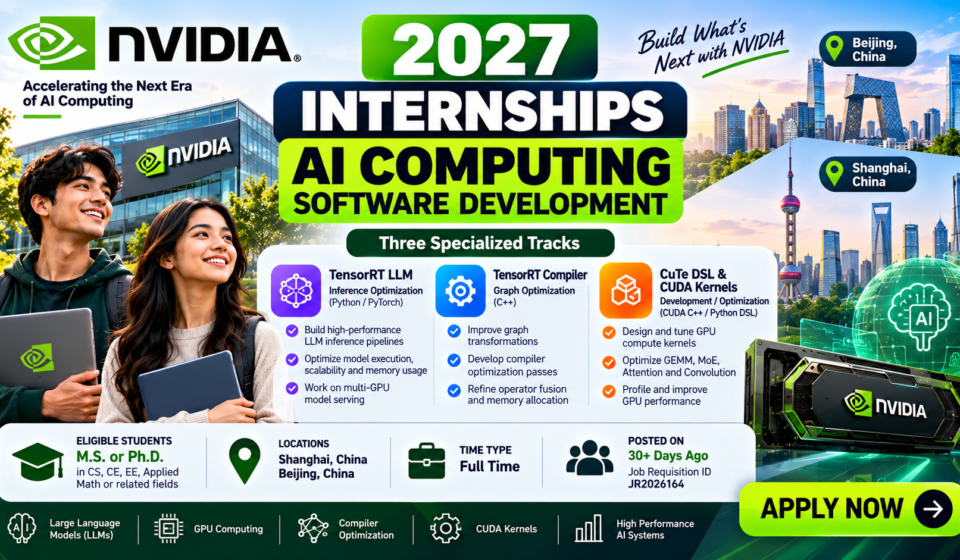
NVIDIA is looking for a full-time AI Computing Software Development intern in Shanghai and Beijing, China, according to the job posting. The opportunity is designed around three technical tracks: TensorRT LLM inference optimization, TensorRT compiler graph optimization, and CuTe DSL and CUDA kernel development.
If you are a student with strong programming skills and are interested in improving AI model performance, compiler technology, or GPU computation, check out the eligibility requirements and apply through the official NVIDIA careers website.
In this article, you will find the internship overview, technical tracks, eligibility criteria, required skills, application process, important links, and frequently asked questions.
About NVIDIA
NVIDIA develops computing platforms and technologies that support artificial intelligence, gaming, robotics, data centers, scientific research, and high-performance computing.
It allows developers and researchers to efficiently train and run complex machine learning algorithms with its GPUs and software libraries. NVIDIA also creates technologies to optimize AI inference, compile software for accelerated computing and improve GPU kernel performance.
For students interested in AI systems engineering, an internship involving TensorRT, CUDA, and compiler optimization can provide exposure to important areas of modern computing.
The precise projects, responsibilities, and selection requirements depend on the internship track and the recruitment team’s decisions.
NVIDIA AI Computing Software Development Internship 2027: Overview
The following table summarizes the details in the supplied job listing.
| Particulars | Details |
|---|---|
| Company | NVIDIA |
| Internship Name | AI Computing Software Development Intern – 2027 |
| Job Requisition ID | JR2026164 |
| Job Category | AI Computing / Software Development |
| Location 1 | Shanghai, China |
| Location 2 | Beijing, China |
| Work Schedule | Full-time |
| Internship Year | 2027 |
| Eligible Degrees | M.S. or Ph.D. |
| Relevant Fields | Computer Science, Computer Engineering, Electrical Engineering, Applied Mathematics, or related fields |
| Technical Areas | AI inference, compiler optimization, CUDA kernels, GPU computing |
| Application Deadline | Not specified in the supplied listing |
| Application Mode | Online |
| Official Application | NVIDIA Careers |
Important: The supplied listing was marked as posted more than 30 days ago. Check the official application page to confirm whether the position is still accepting applications. The listing provided does not specify the internship duration, stipend, or a fixed application deadline.
Internship Tracks and Responsibilities
The NVIDIA AI Computing Software Development Internship includes three specialized technical tracks. Applicants should understand the differences between these areas and identify the one that best matches their academic background and practical experience.
1. TensorRT LLM – Inference Optimization
This track focuses on building and improving high-performance inference pipelines for large language models.
AI inference is the process of using a trained machine learning model to generate predictions or responses. Efficient inference is particularly important for LLM applications because these models can require substantial GPU memory and computational resources.
Potential responsibilities include:
- Building and enhancing LLM inference pipelines.
- Analyzing model execution and identifying performance bottlenecks.
- Optimizing memory usage and scalability.
- Improving multi-GPU model serving.
- Collaborating with framework and research teams.
- Investigating opportunities to improve inference performance.
Relevant skills and technologies:
- Python programming
- PyTorch
- TensorRT LLM
- Deep learning fundamentals
- GPU acceleration
- Model inference
- Memory optimization
- Performance analysis
- Multi-GPU computing
Who should consider this track?
Students who have experience with Python, PyTorch, deep learning models, and performance optimization may find this track relevant. Understanding how models execute on GPUs can help candidates develop a stronger foundation for inference engineering.
2. TensorRT Compiler – Graph Optimization
The TensorRT Compiler track focuses on optimizing computational graphs and code generation for NVIDIA GPUs.
Deep learning models contain operations that must be organized and executed efficiently. Compiler optimizations can improve performance by transforming computational graphs, combining operations, and managing memory more effectively.
Potential responsibilities include:
- Developing compiler optimization passes.
- Improving graph transformations.
- Refining code generation for NVIDIA GPUs.
- Optimizing operator fusion.
- Improving memory allocation.
- Investigating performance bottlenecks.
- Collaborating with CUDA and hardware architecture teams.
Relevant skills and technologies:
- C++ programming
- Compiler fundamentals
- Compiler optimization
- Graph transformations
- Code generation
- Operator fusion
- Memory allocation
- Computer architecture
- Performance optimization
- GPU computing
Who should consider this track?
This track may suit students who enjoy systems programming, compiler construction, algorithms, and performance engineering. Experience with compiler internals or optimization techniques can be useful when applying for this area.
3. CuTe DSL and CUDA Kernels Development / Optimization
This track focuses on designing and optimizing GPU compute kernels for deep learning operations.
A GPU kernel is a program that executes computations on a graphics processing unit. Carefully optimized kernels can improve the speed and efficiency of workloads used in modern AI systems.
The listing identifies several important computational operations, including GEMM, MoE, attention, and convolution.
Potential responsibilities include:
- Designing and tuning GPU compute kernels.
- Developing implementations using CUDA C++ or Python-based DSLs.
- Profiling kernel execution.
- Identifying computational bottlenecks.
- Improving GPU resource utilization.
- Optimizing performance for deep learning operations.
Relevant skills and technologies:
- C and C++
- CUDA C++
- Python
- Parallel programming
- GPU architecture
- Performance profiling
- Kernel optimization
- LLVM and MLIR familiarity
- Compiler fundamentals
- Memory and computation optimization
Who should consider this track?
Students interested in GPU architecture, parallel programming, CUDA development, and low-level performance optimization may find this track particularly suitable.
Understanding the Key Technologies
Candidates can strengthen their applications by understanding the technologies mentioned in the internship description.
TensorRT LLM
TensorRT LLM is NVIDIA’s software library for optimizing and deploying large language model inference on NVIDIA GPUs. It focuses on efficient execution of LLM workloads.
PyTorch
PyTorch is a machine learning framework widely used to develop, train, and execute deep learning models. Python and PyTorch knowledge are particularly relevant to the TensorRT LLM inference track.
CUDA
CUDA is NVIDIA’s parallel computing platform and programming model for GPU computing. It allows developers to write programs that perform computations on NVIDIA GPUs.
TensorRT Compiler
The TensorRT compiler technology helps optimize deep learning computation for execution on supported NVIDIA hardware. The internship’s compiler track focuses on graph transformations, code generation, and related optimization work.
CuTe DSL
CuTe DSL provides programming abstractions for developing GPU kernels. It is relevant to low-level GPU computation and optimization of deep learning operations.
LLVM and MLIR
LLVM and MLIR are compiler-related technologies used in software toolchains and compiler infrastructure. Familiarity with these technologies may be useful for candidates pursuing compiler and kernel development work.
What Do GEMM, MoE, Attention, and Convolution Mean?
The internship listing mentions several operations used in deep learning systems.
| Term | Meaning | Why It Matters |
|---|---|---|
| GEMM | General Matrix-Matrix Multiplication | A fundamental operation in many neural network computations |
| MoE | Mixture of Experts | A model architecture that routes inputs to selected expert networks |
| Attention | A mechanism that helps models determine relationships between input elements | Central to Transformer-based models and many LLMs |
| Convolution | An operation used to extract local patterns from data | Common in computer vision and image-processing models |
Optimizing these operations can improve computational throughput, memory efficiency, and overall model performance.
Eligibility Criteria for NVIDIA AI Computing Internship 2027
Candidates should review the stated eligibility requirements before applying.
Educational Qualifications
The supplied listing specifies applicants pursuing an M.S. or Ph.D. in one of the following fields:
- Computer Science
- Computer Engineering
- Electrical Engineering
- Applied Mathematics
- A related field
The listing does not identify bachelor’s degree students as eligible for this particular opportunity. Applicants should check the official job page for any updated requirements.
Strong Problem-Solving Skills
NVIDIA is looking for candidates with strong problem-solving abilities, curiosity about advanced AI systems, and an interest in GPU computing and deep learning software performance.
Students should be prepared to demonstrate their ability to investigate technical problems, understand algorithms, and improve software performance.
Programming Requirements
Programming requirements depend on the selected track.
For TensorRT LLM – Inference Optimization:
- Strong Python programming skills.
- Experience with PyTorch.
- Understanding of inference and GPU acceleration.
For TensorRT Compiler – Graph Optimization:
- Proficiency in C++.
- Experience with compilers or performance optimization.
For CuTe DSL and CUDA Kernel Development:
- Skills in C/C++ and CUDA or parallel programming.
- Familiarity with LLVM, MLIR, and compiler technology.
- Understanding of computer architecture and performance profiling.
Candidates should concentrate on the track that most closely matches their actual experience.
NVIDIA Internship Stipend and Benefits
The supplied job description does not state a specific stipend or hourly compensation range for this position.
Therefore, applicants should not assume that the compensation is the same as other NVIDIA internship listings. Check the official application page and any recruiter communications for accurate compensation details.
The supplied listing also does not specify the internship duration or a detailed benefits package for this role.
Candidates should verify employment terms, internship dates, relocation arrangements, and applicable benefits directly with NVIDIA.
Documents to Prepare Before Applying
The supplied listing does not provide a complete document checklist. However, candidates can prepare the following materials where applicable:
- An updated resume or CV.
- Details of their M.S. or Ph.D. program.
- Relevant academic and research projects.
- A list of programming languages and technical skills.
- Details of previous internships or software development experience, if any.
- GitHub repositories, research publications, or technical portfolios, if available.
- Any additional information requested in NVIDIA’s official application form.
For this opportunity, candidates should highlight work relevant to AI inference, CUDA, compiler development, GPU computing, or performance optimization.
Only include skills, projects, and research achievements that accurately represent your experience.
How to Apply for NVIDIA AI Computing Software Development Internship 2027
Follow these steps to review and submit your application.
Step 1: Visit the Official NVIDIA Careers Page
Open the official application link:
Step 2: Check the Current Application Status
Because the supplied listing was posted more than 30 days ago, confirm that the application is still open before proceeding.
Step 3: Review the Eligibility Requirements
Check the required degree level, academic field, programming skills, and track-specific experience.
Step 4: Select Your Relevant Technical Track
Review the responsibilities of the three tracks:
- TensorRT LLM – Inference Optimization
- TensorRT Compiler – Graph Optimization
- CuTe DSL and CUDA Kernels Development / Optimization
Identify the track that best matches your knowledge and project experience.
Step 5: Update Your Resume
Highlight relevant programming languages, research projects, GPU computing experience, compiler work, and machine learning projects.
Explain what you developed, the technical challenges you addressed, and the results you achieved.
Step 6: Complete the Online Application
Provide the information requested on the official careers website and upload the required documents.
Step 7: Submit and Monitor Your Application
Review your application for accuracy before submitting. Monitor your email for any communication from NVIDIA’s recruiting team.
Tips to Strengthen Your Application
1. Build a Relevant Technical Project
Create a project that demonstrates your skills in the track you want to pursue.
Examples include a PyTorch inference benchmark, a C++ compiler optimization project, or a CUDA kernel implementation.
2. Practice Python or C++ Programming
Python is particularly relevant to the inference optimization track, while C++ is important for compiler development. C/C++ and CUDA knowledge are relevant to GPU kernel development.
3. Learn GPU Performance Profiling
Understanding how to measure execution time, memory usage, and computational bottlenecks can help you explain your optimization work.
4. Study Computer Architecture
Learn about GPU execution, memory hierarchies, parallel computation, and how software interacts with hardware.
5. Understand Deep Learning Fundamentals
Familiarity with neural networks, Transformer architectures, inference, and common tensor operations can be useful for AI computing roles.
6. Document Your Work Clearly
Use your resume and project portfolio to explain your contribution, methodology, and measurable results. Avoid unsupported claims about performance improvements.
Important Links
| Resource | Link |
|---|---|
| NVIDIA AI Computing Software Development Intern – 2027 | Apply Online |
| NVIDIA Careers | Official Careers Website |
| NVIDIA Internship Benefits | View Benefits Information |
| NVIDIA Applicant Privacy Policy | Read Privacy Policy |
Always use the official NVIDIA careers website to verify the current vacancy status and submit your application.
Frequently Asked Questions (FAQs)
1. What is the NVIDIA AI Computing Software Development Internship 2027?
It is an internship opportunity focused on advanced AI computing technologies, including LLM inference optimization, compiler graph optimization, and GPU kernel development.
2. Where are the internship locations?
The supplied listing identifies Shanghai and Beijing in China.
3. Who can apply for this internship?
The supplied listing specifies students pursuing an M.S. or Ph.D. in Computer Science, Computer Engineering, Electrical Engineering, Applied Mathematics, or a related field.
4. Which technical tracks are available?
The listing describes three tracks: TensorRT LLM inference optimization, TensorRT compiler graph optimization, and CuTe DSL and CUDA kernel development or optimization.
5. Is Python required?
Strong Python skills and PyTorch experience are specified for the TensorRT LLM inference optimization track. Python may also be relevant to CUDA kernel development using a Python-based DSL.
6. Is C++ required?
C++ proficiency is specified for the TensorRT compiler track. C/C++ and CUDA or parallel programming skills are relevant to the CuTe DSL and CUDA kernel track.
7. What is the stipend for this internship?
The supplied job description does not specify the stipend or hourly pay. Candidates should check the official job page or contact NVIDIA’s recruiting team for compensation details.
8. What is the internship duration?
The supplied description does not specify the internship duration. Candidates should confirm the dates and duration through the official application page or recruiter.
9. Is the application deadline available?
No fixed deadline is included in the supplied description. The listing was marked as posted more than 30 days ago, so candidates should check the official page to confirm whether applications remain open.
10. How can I apply?
Visit the official NVIDIA application page, review the eligibility requirements, prepare your resume, and complete the online application if the vacancy is still open.
Conclusion
The NVIDIA AI Computing Software Development Internship 2027 is an opportunity for postgraduate students interested in AI systems, GPU computing, compiler technology, and deep learning performance optimization.
With three specialized technical tracks, the opportunity covers important areas of modern AI infrastructure, including LLM inference, compiler graph transformations, and CUDA kernel optimization.
Students should review the track-specific skills, prepare a focused technical resume, and verify the current vacancy status before applying.
Ready to explore this opportunity?
Visit the Official NVIDIA Application Page
Stay Connected with LatestInternships.com.
LatestInternships.com shares information about internships, technology programs, recruitment opportunities, and career resources to help students explore professional opportunities.
Visit our website regularly for internship updates, and share this article with postgraduate students interested in AI engineering, GPU programming, and advanced software development.
Disclaimer: LatestInternships.com is an independent informational platform and is not affiliated with NVIDIA. This article is based on the job details supplied for publication. Eligibility, vacancy status, compensation, and other conditions may change. Verify all information through NVIDIA’s official careers website before applying.



[…] Also Read: NVIDIA AI Computing Software Development Internship 2027 – Apply Online […]